Roof Replacement in Concord, MO: The Two-Inspection Case Study
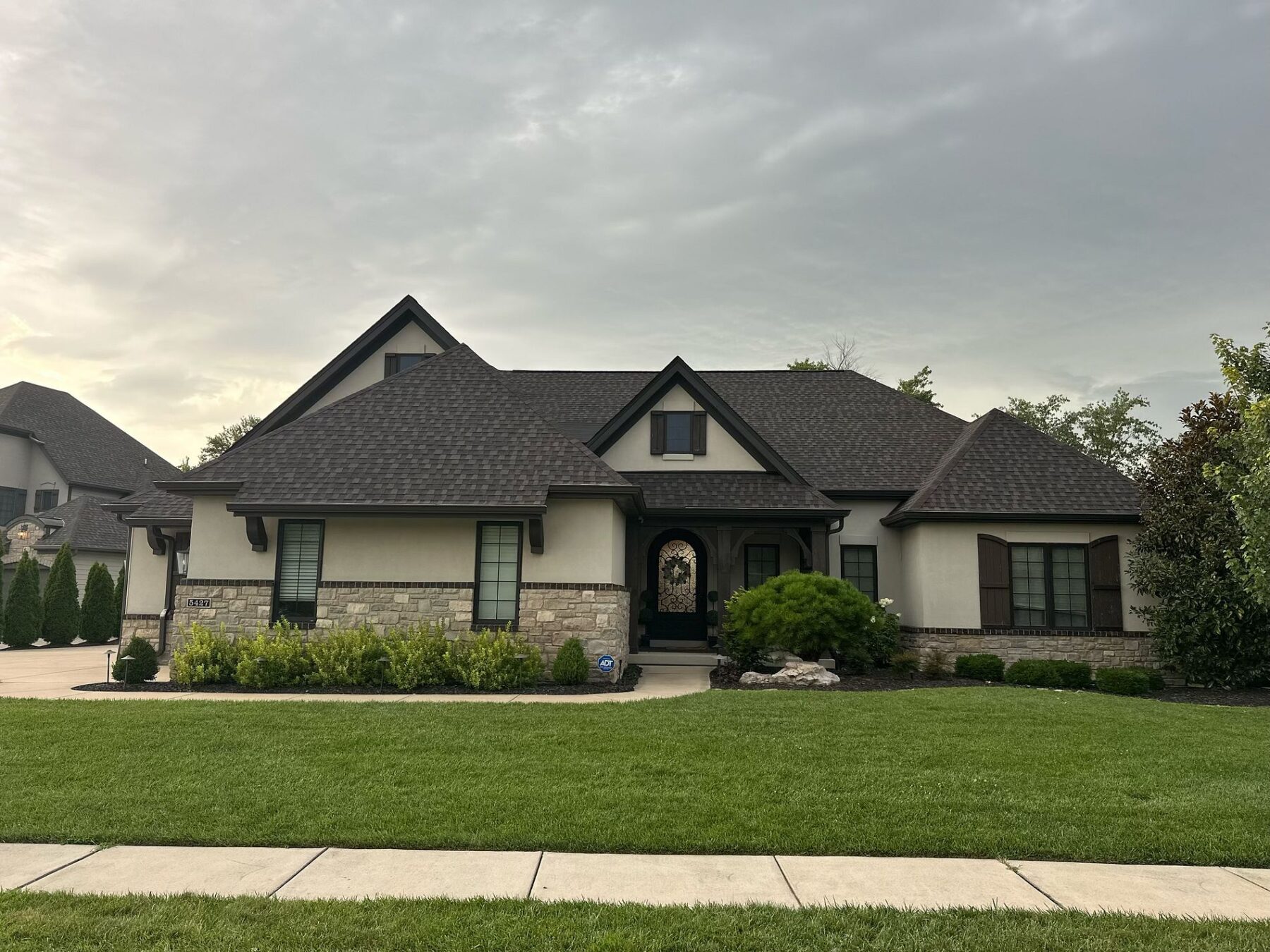
When we first inspected this Concord, MO roof, we told the homeowner he didn’t need a roof replacement. Storms had recently moved through South St. Louis County, several neighbors were replacing their roofs, and he simply wanted to know the condition of his own.
Our team completed a thorough roof inspection, documented what we found, and gave him a straightforward answer: there was no reason to file an insurance claim or replace the roof at that time.
The following storm season was different. Hail reached his Concord property and caused legitimate damage to both the roof and gutters. Because he knew he could trust the advice we had given him the first time, St. Louis Residential Roofing was the company he called when he actually needed help.
About the Project
- Location: Concord, unincorporated South St. Louis County
- Scope: Full asphalt shingle roof replacement, plus a modified bitumen low-slope system on one roof section
- Related work: Storm-damaged gutters; replacement scheduled as a follow-up phase
- Why it is worth reading: two inspections a season apart with opposite outcomes, and a design vulnerability caught before it became an interior repair
Concord sits in the corridor bounded by Lindbergh Boulevard, Tesson Ferry Road, and Gravois Road, between I-270 and I-255. It is one of the most established parts of South County. The great majority of homes in the 63128 ZIP were built before 1980, with the largest share going up in the 1950s and 1960s. Homes of that generation have been re-roofed several times, and the roof designs are frequently more complicated than they look from the driveway: additions, porch and carport roofs, and roof planes that were added at different times and now drain into each other.
Because Concord is unincorporated, there is no city building department. Permits and inspections for this project ran through St. Louis County, which is a difference worth knowing if you live here: the requirements, the inspection sequence, and the timing are the county’s, not a municipality’s. We pull the permits and schedule the inspections either way.
Inspection One: No Damage, No Replacement
The first inspection came after a round of storms moved through the metro. This is the busiest moment in our year and the moment when homeowners are most likely to be sold something they do not need. Trucks appear in the neighborhood, someone knocks, and the pitch is that everyone on the street is getting a new roof.
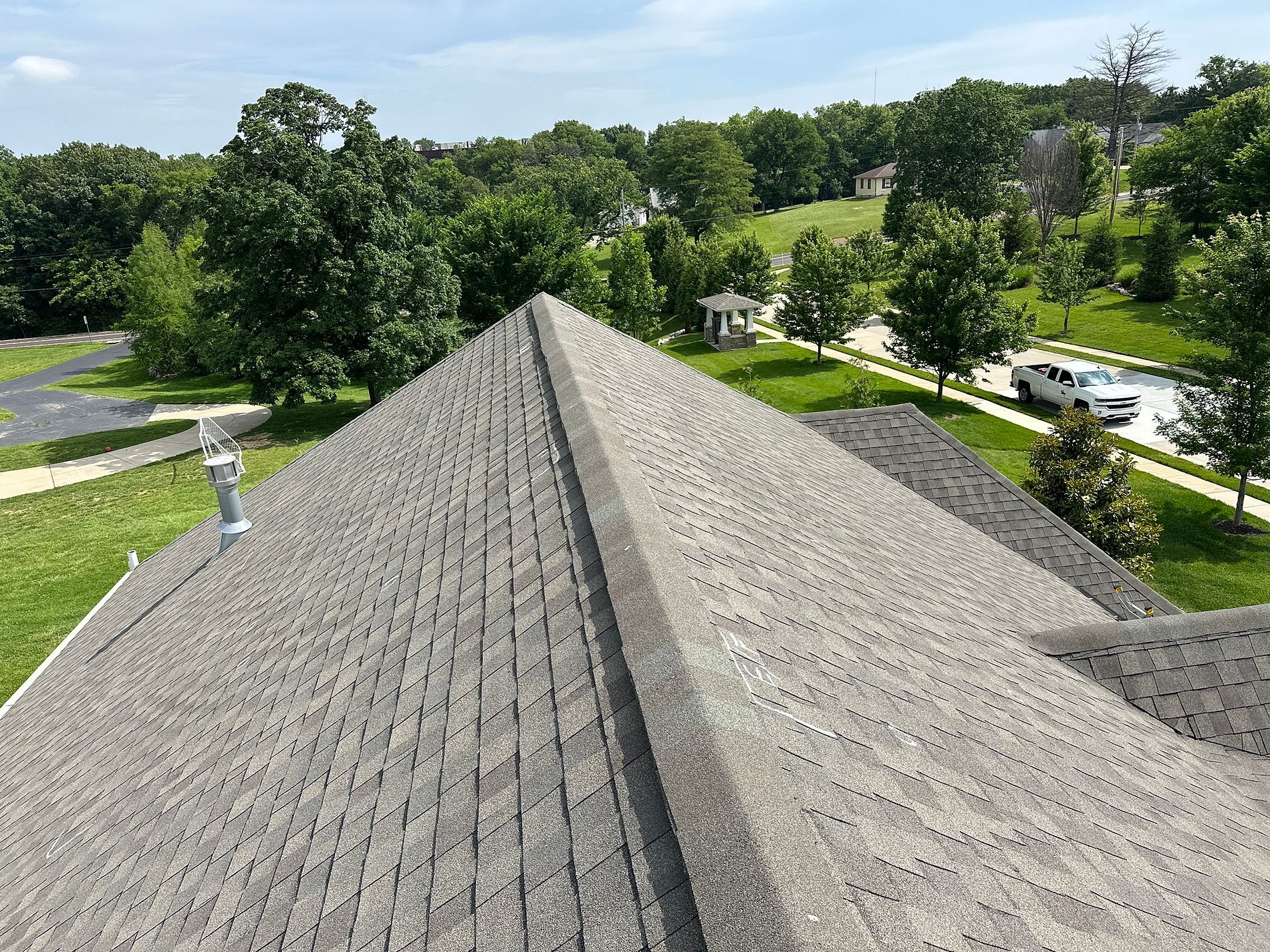
We inspected the roof, documented the condition with photographs, and found minor hail damage. The shingles were intact, the granule surface was in good shape for the roof’s age, and the flashings were sound. So that is what we told the homeowner: the roof was still in good condition and did not need to be replaced.
We have walked more than 10,000 roofs across the St. Louis metro, and telling homeowners they do not need a new roof is a routine part of the job, not a rare gesture. A roof either has damage or it does not. When it does not, saying so costs us a job in the short term and earns us the only thing that actually matters in a referral business.
Two practical notes for homeowners in the same position:
- A “no damage” finding is worth having in writing. Photographs and a dated report establish the roof’s condition at a point in time. If a later storm does cause damage, that record helps show what changed.
- A “no damage” finding has a shelf life. It describes the roof on the day we were on it. It is not a forecast.
Inspection Two: Hail, and a Second Look at the Whole System
The following season, another round of hail reached the property. This time the inspection told a different story: the roofing system and the gutters had both been impacted, and a full replacement was the right call.
We inspected the roof, documented the visible damage with photographs, prepared a detailed roofing estimate, and explained the work we believed was needed. When the approved scope needed supporting information, we supplied additional photographs, measurements, manufacturer requirements, and code information for the homeowner and the carrier to review. Coverage decisions and claim negotiations remain between the homeowner and the insurance carrier. Our job is to make sure the roofing facts in front of everyone are complete and accurate.
Damage assessment: what the second inspection documented
- Hail impact across the asphalt shingle roofing system, consistent with the storm event
- Hail damage to the gutters and downspouts
- A very low-sloped roof section covered with standard asphalt shingles, receiving concentrated drainage from two higher roof planes; pre-existing, unrelated to the storm, and not leaking
- No active interior water damage at the time of inspection
Hail does not stop at the shingles. On this property the gutters were damaged too, which is common and frequently under-noticed. Aluminum gutters dent and dimple, downspouts get struck, and a gutter run that has been deformed no longer carries water the way it was sized to. Homeowners look up at the roof and never look at the gutter face. Gutter replacement on this home is scheduled as a follow-up phase.
The Part That Was Not in the Claim: A Low-Slope Section Waiting to Cause Trouble
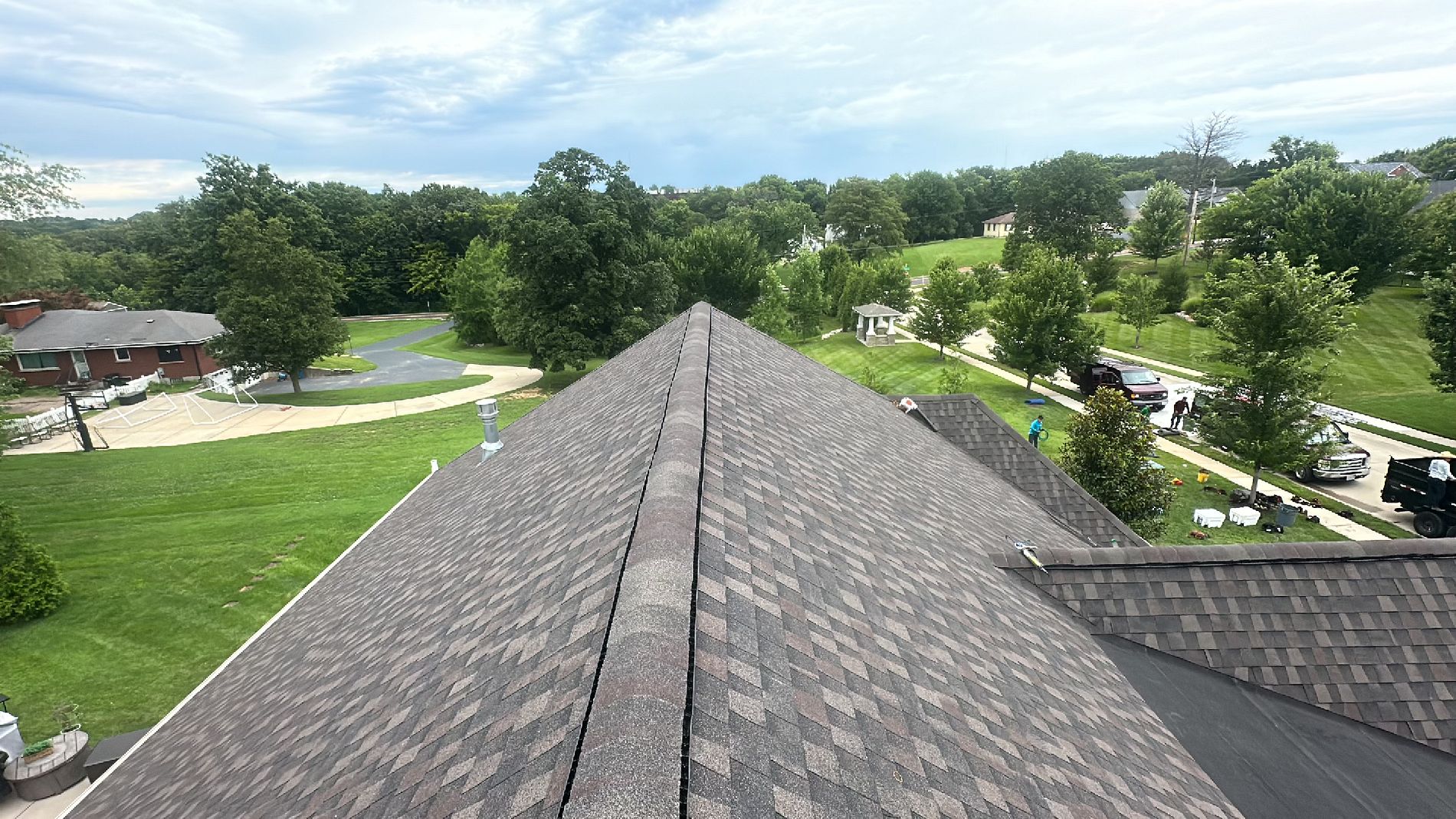
While documenting the roof, Thomas identified something unrelated to the storm. One section of this roof is very low-sloped, and two higher roof planes drain onto it. Everything that falls on those upper areas, including rain, snowmelt, and the debris that comes with them, is funneled onto a nearly flat surface that had been covered with standard asphalt shingles.
The homeowner had never had a leak there. That is exactly why it is worth writing about.
Why shingles are the wrong material for that section. Asphalt shingles are a water-shedding covering, not a waterproof one. They are a series of overlapping layers that rely on slope and gravity to move water down and off the roof before it can find a seam. Take the slope away and the whole logic breaks down: water moves slowly, sits in the laps, and gets more opportunity to work its way sideways and backward instead of down.
The building code sets a hard floor of 2:12, two inches of rise for every twelve inches of run, as the minimum slope for asphalt shingles, and requires a doubled underlayment application anywhere between 2:12 and 4:12. GAF’s own installation guidance is blunt about it: “Slopes lower than 2:12 do not have enough slope to shed water properly… Low-slope roofs should be protected by low-slope roofing materials.” The National Roofing Contractors Association is more conservative still, recommending 4:12 as the minimum for shingle roofs, and naming the specific risk as water backup from wind-driven rain or ice damming: “particularly with low-slope asphalt shingle roof areas with valleys or roof system penetrations.”
Two failure modes were building here, neither of them visible yet.
Standing water. Water that cannot drain off a low-slope area stays there. The roofing industry defines ponding water as water that remains on a roof 48 hours or longer, and it is destructive in slow motion. Added weight deflects the deck, which deepens the low spot, which holds more water. Organic growth follows, debris collects, and the surface degrades from the top down. On a shingle surface, none of that announces itself until water finds a way in.
Ice. In a St. Louis winter, that same section is where melting snow from the two upper roof planes arrives and slows down. If it refreezes there, an ice dam forms, water backs up behind it, and it starts looking for a lap to get under. On a shallow slope, it has far more room to work than it would on a steep one. Ice is also physically abrasive: as it forms and moves with temperature swings, it scrubs at the roof surface.
Nothing had leaked yet. Both of those processes were still in their early stages. Which is the best possible time to fix them, and the only time you can fix them for the cost of a roofing material upgrade instead of the cost of a roofing repair plus drywall, insulation, paint, and whatever the water found on its way through.
The Solution: Modified Bitumen Where Shingles Do Not Belong
Thomas recommended installing modified bitumen, or “mod bit,” on that low-slope section instead of shingles.
What modified bitumen is. Asphalt with polymers added to it, reinforced with fiberglass or polyester and manufactured in rolls rather than individual shingles. The polymer is the point: it gives the membrane flexibility in cold weather and the ability to stretch and recover instead of cracking. The most common residential type is SBS, styrene-butadiene-styrene, the same rubberizing chemistry that makes Class 4 impact-resistant shingles flex instead of shatter under hail, which is a useful thing to know if you have already read our Class 4 guide.
Why it works where shingles do not. Mod bit is installed as a continuous membrane with sealed laps rather than as hundreds of loose overlapping pieces. It is designed to be waterproof rather than water-shedding, which is what a nearly flat surface actually requires. Where asphalt shingles bottom out at 2:12, the GAF low-slope system we install is rated down to ¼:12, a slope so shallow it barely reads as a slope at all.
How it is installed matters, especially on an occupied home. Mod bit can be torch-applied, hot-mopped, set in cold adhesive, or self-adhering, a peel-and-stick membrane that needs no open flame. On a low-slope section sitting on a wood deck and tying into wood-framed walls, self-adhering is the right answer, and not only for comfort. Industry fire-safety standards for torch work are explicit that a torch is never applied directly to combustible material or into concealed spaces where the flame path cannot be seen, and torch-applied work carries a mandatory fire watch after the equipment is shut down. A roof section like this one, with a shingle tie-in and hidden voids at the wall, is exactly the condition those standards exist for. We used a self-adhering system.
The GAF system, and why our certification matters here. We installed GAF’s LIBERTY™ Self-Adhering low-slope system, a two-ply assembly of the LIBERTY™ Self-Adhering Base/Ply Sheet and LIBERTY™ Self-Adhering Cap Sheet, with matching primer and flashing cement. Two details are worth calling out:
- The two-ply LIBERTY™ system passes UL 2218 Class 4 impact resistance, the same top hail rating we talk about with impact-resistant shingles. On a roof in a hail-active metro, that is not a small thing for the one section that was previously the weakest.
- GAF publishes a Golden Pledge® Limited Warranty Addendum specifically for low-slope roofs, written for combination steep- and low-slope roofs exactly like this one, and it requires a GAF Master Elite® contractor. Because we hold that certification (fewer than 2% of roofing contractors in North America do), this homeowner’s shingle roof and low-slope section can be addressed under one enhanced GAF warranty structure rather than falling into a gap between two systems. Eligibility, coverage, exclusions, and registration requirements are reviewed with the homeowner before installation, and coverage varies by product, roofing system, installation requirements, property type, and warranty registration.
The cap sheet comes in a range of colors selected to coordinate with GAF Timberline® shingles, so the section reads as part of the roof rather than as a patch.
Protecting the Property During the Work
A roof replacement is a demolition project happening above someone’s landscaping, driveway, and windows. On this project, as on every project:
- Catch-All tarp ground protection around the perimeter, so tear-off debris lands on a system rather than on the yard
- Landscaping, walkways, and the driveway covered and shielded before anything comes off the roof
- Organized workflow through the day, with debris moved off the property rather than accumulating
- An STLRR project manager on site throughout, an employee of ours rather than a subcontracted coordinator, so there is one accountable person present all day
Why This Project Matters for South County Homeowners
A roofing company that will not tell you no is not giving you information. The first inspection on this house produced no claim and no revenue. If the same company had found “damage” on the first inspection and again on the second, the second finding would have been worthless, and the homeowner would have had no way to know.
Storm damage is the trigger for a replacement, not the whole scope of one. The hail is what brought us back. The low-slope drainage problem is what the homeowner actually got the most long-term value from, and it had nothing to do with the storm. When a roof is coming off anyway, that is the one moment when correcting an underlying design weakness costs almost nothing extra. Miss it, and it stays wrong for another twenty years.
The right material for a roof section depends on that section, not on the rest of the roof. Most of this roof needed shingles. One part of it needed something shingles cannot do. A roof is a system of surfaces, penetrations, transitions, and drainage paths, and treating all of it as “shingles” is how avoidable leaks get built into a brand-new roof. That system-level habit comes from our background. St. Louis Residential Roofing was founded by custom home builders and former roof consultants, and it is the difference between replacing a roof and improving one.
Get an Honest Look at Your Roof
If you are in Concord, Sappington, Affton, Green Park, Mehlville, or anywhere across South St. Louis County and you want to know where your roof actually stands, we will tell you straight, including when the answer is that you do not need us yet.
Our inspection is free, there is no pressure, and if we find a low-slope section, a drainage problem, or a ventilation issue while we are up there, you will hear about it before it becomes a leak.
Call (314) 248-3544 (Missouri) or 618-312-6677 (Illinois), or request a free inspection online. St. Louis Residential Roofing is a GAF Master Elite® certified, residential-only roofing contractor serving St. Louis County, St. Charles County, and Metro East Illinois.
BEFORE & AFTER