What Are the Black Streaks on My Roof? A St. Louis Homeowner’s Guide to Roof Algae (2026)
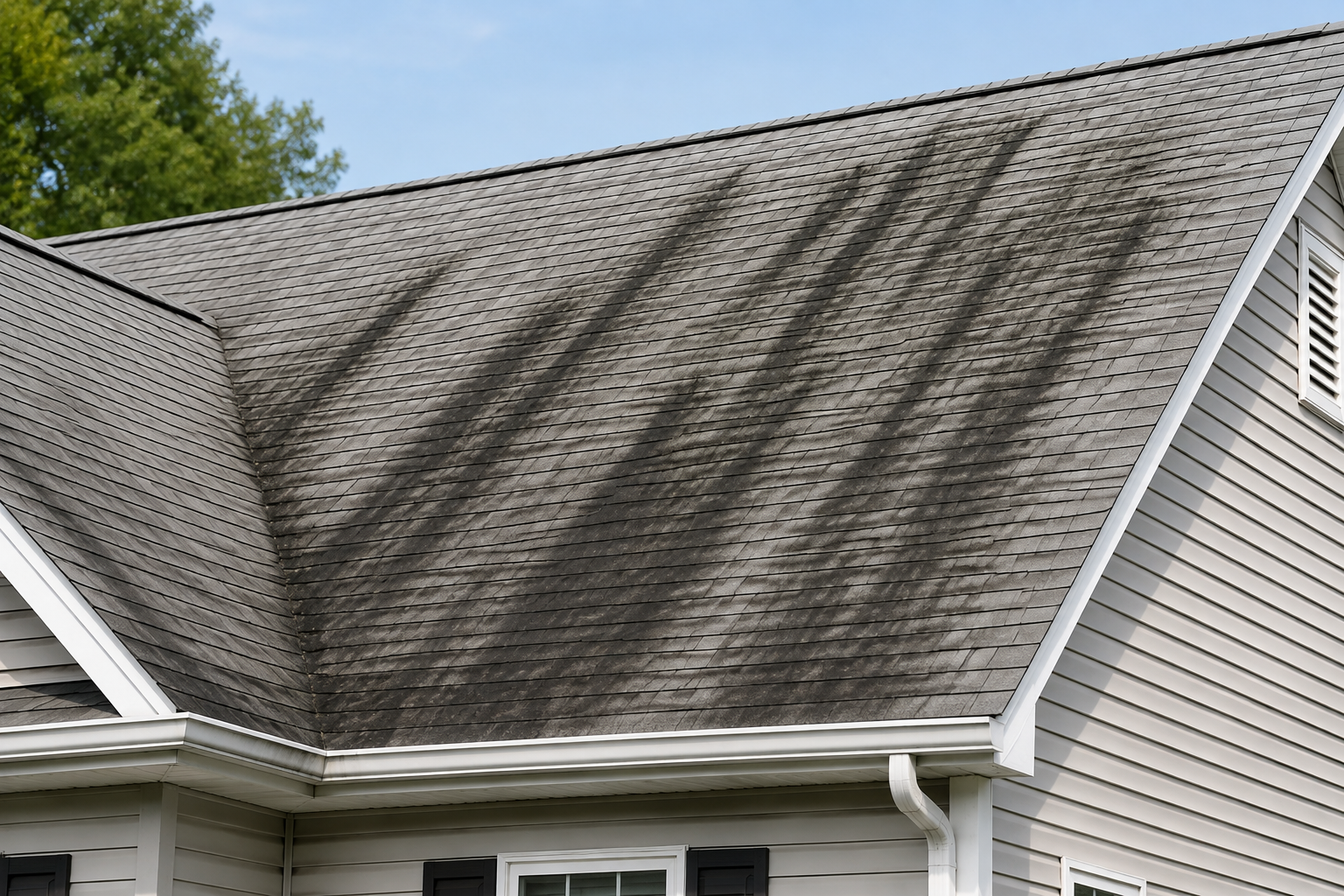
Those black streaks running down your roof are not dirt, soot, or a sign the shingles are “wearing out.” They are a blue-green algae called Gloeocapsa magma, and in the warm, humid St. Louis climate it is extremely common. The algae feed on the limestone filler in asphalt shingles and produce a dark protective coating that shows up as the streaks you see from the street. It is treatable, and it is preventable.
If you own a home anywhere from Chesterfield to Kirkwood, Webster Groves to O’Fallon, you have almost certainly seen these dark stains, usually running downward and most often on the north-facing or shaded slopes of a roof. They tend to appear a few years after a roof is installed and spread gradually. The good news is that black streaks rarely mean your roof is failing. The important part is knowing what causes them, how to remove them safely, and how to keep them from coming back, because doing it wrong can void your warranty and shorten the life of your roof.
What Actually Causes Black Streaks on a Roof?
The stains are caused by Gloeocapsa magma, an airborne algae that settles on roofs and thrives in warm, moist conditions, exactly the environment a St. Louis summer provides. Once it takes hold, it feeds on the limestone (calcium carbonate) filler used in asphalt shingles. The organism itself is blue-green, but it produces a dark, pigmented sheath to protect itself from the sun’s UV rays. That dark sheath is what you see as black streaks.
A few things worth understanding as a homeowner:
- It spreads by air. Spores travel on the wind from roof to roof, which is why you often see it move through a neighborhood. If your neighbor’s roof is streaked, yours is a candidate.
- Shaded, north-facing slopes get it first. These areas stay damp longer because they get less direct sun, giving the algae more time to grow.
- It is not the same as moss or lichen. Moss is green and three-dimensional (it holds moisture against the roof and is more damaging); lichen is a crusty, tightly attached growth. Algae is the flat, dark staining. All three are worth a professional look, but they are different problems.
Are Black Streaks Actually Damaging My Roof?
Mostly, black streaks are a cosmetic problem, but they are not entirely harmless. As the algae consume the limestone filler, they gradually degrade the shingle’s ability to reflect heat and can accelerate granule loss over time. A darker roof also absorbs more heat, which raises attic temperatures and adds strain to shingles and cooling costs during St. Louis summers. Left unaddressed for years, heavy algae, and especially the moss and lichen that often follow, can shorten a roof’s usable life.
The bigger issue for most homeowners is curb appeal and resale. Black streaks make a roof look old and neglected even when it has plenty of life left, and in a market like West St. Louis County, that appearance can cost you at the negotiating table.
How to Remove Black Streaks Safely (and What Never to Do)
Never pressure wash an asphalt shingle roof.
High-pressure washing can loosen or remove the protective granules from the shingles, force water beneath roofing materials, and potentially affect manufacturer warranty coverage.
Before attempting to clean or treat the roof, have its overall condition evaluated. What appears to be surface staining may be occurring alongside normal aging, granule loss, damaged shingles, moss, lichen, or ventilation concerns.
Professional roof-cleaning methods are available in some situations, but the appropriate recommendation depends on the age and condition of the roofing system.
St. Louis Residential Roofing does not provide roof-cleaning services. However, we can inspect the roof and help determine whether the staining appears cosmetic or whether there are roofing concerns that should be addressed.
How to Prevent Black Streaks From Coming Back
Homeowners can take several steps that may help reduce the conditions that allow algae and other organic growth to develop:
- Trim overhanging branches when appropriate to improve sunlight and airflow.
- Keep gutters and drainage systems clear.
- Make sure the attic ventilation system is properly balanced.
- Choose shingles with algae-fighting technology when replacing the roof.
No roofing product can prevent every type of staining in every environment, but algae-resistant shingles can help reduce blue-green algae discoloration and preserve the appearance of the roof.
Do Algae-Resistant Shingles Really Work?
Many modern asphalt shingles are manufactured with technology designed to help resist blue-green algae discoloration.
As a GAF Master Elite® contractor, St. Louis Residential Roofing installs qualifying GAF shingles featuring StainGuard Plus™ algae-fighting technology.
GAF Timberline® HDZ shingles use specially engineered copper-containing granules that are designed to release algae-fighting components over time. Timberline® UHDZ shingles are also available with enhanced algae-discoloration protection.
Available warranty coverage varies by product, roofing system, installation requirements, property type, and warranty registration. We review the applicable product and warranty information with homeowners before installation.
We also install CertainTeed and Owens Corning roofing systems, including available algae-resistant and impact-resistant options.
Does a Streaked Roof Need to Be Replaced?
Not necessarily.
A newer roof with surface staining may still have many years of useful life remaining. An older roof may have staining along with brittle shingles, granule loss, damaged flashing, ventilation concerns, or other signs of deterioration.
The appearance of the roof alone does not determine whether replacement is necessary.
An inspection can help separate a cosmetic concern from a roofing problem and provide a clearer understanding of the roof’s overall condition.
At St. Louis Residential Roofing, we often tell homeowners they do not need a new roof. Sometimes no immediate roofing work is necessary. In other cases, an isolated repair may be appropriate. When a roof has reached the end of its useful life, we explain what we see and review the available replacement options without pressure.
| Option | Best for | Watch out for |
|---|---|---|
| Professional soft wash | Newer roofs with life left, cosmetic staining only | Streaks can return in a few years without prevention |
| DIY cleaning | Handy homeowners, single-story, low-slope roofs | Safety risk; easy to damage granules; warranty risk |
| Pressure washing | Never recommended on shingles | Strips granules, voids warranties, shortens roof life |
| Copper/zinc strips (add-on) | Preventing regrowth after cleaning | Reduces but doesn’t fully eliminate on old roofs |
| Replace with algae-resistant shingles | Older or heavily stained roofs near end of life | Higher upfront cost; solved for 25-30 yrs under warranty |
Frequently Asked Questions About Black Streaks
Why is my roof turning black in streaks?
The black streaks are Gloeocapsa magma, a blue-green algae that feeds on the limestone filler in asphalt shingles and produces a dark, UV-protective coating. It thrives in the warm, humid conditions common across the St. Louis metro and spreads through airborne spores, which is why it often appears on multiple homes in the same neighborhood and shows up first on shaded, north-facing slopes.
Do black streaks mean I need a new roof?
Not usually. In most cases black streaks are a cosmetic issue and the roof still has useful life left. However, long-term algae growth can accelerate granule loss, and streaks often accompany an aging roof. The only way to know whether you need a cleaning, a preventive upgrade, or a replacement is a professional inspection that evaluates the shingle condition underneath the staining.
Can I pressure wash the algae off my roof?
No. Pressure washing strips the protective granules off asphalt shingles, can drive water under the shingles, and voids most manufacturer warranties.
Will the black streaks come back after cleaning?
They can, usually within a few years, unless you address prevention. Installing copper or zinc strips near the ridge, improving sunlight and airflow to shaded slopes, and (at replacement time) choosing algae-resistant shingles.
Are algae-resistant shingles worth it in St. Louis?
Algae-resistant shingles can be a worthwhile option in the warm, humid St. Louis climate, particularly for homes with shaded or north-facing roof slopes.
When replacing a roof, homeowners can compare available algae-resistant products, impact-resistance ratings, warranty options, appearance, and overall cost.
Get an Honest Look at Your Roof
If black streaks have you wondering whether your roof needs a cleaning or a replacement, we will tell you straight. Our free, no-pressure inspection evaluates the shingle condition beneath the staining, checks your ventilation, and lays out your options so you can decide based on the facts.
Call (314) 248-3544 (Missouri) or 618-312-6677 (Illinois), or request a free inspection online. We serve homeowners throughout St. Louis County, St. Charles County, and Metro East Illinois.